Copenhagen
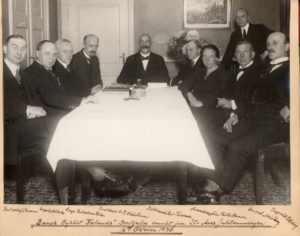
Helga Crane, the protagonist in Nella Larsen’s Quicksand, has family ties to Copenhagen, Denmark (as does the author). Her mother emigrated to the United States prior to Helga’s birth and her aunt, Fru Katrina Dahl, still lives with her husband, Herr Poul Dahl, in the city. In a need to escape New York City because life “became for [Helga] only a hateful place where one lived in intimacy with people one would not have chosen had one been given a choice,” she flees to Copenhagen upon her Uncle Peter’s suggestion and relationship severing bequest of $5,000. While in the new, familial city Helga is lavished upon by her family and they show her off to their circle of friends and acquaintances. She “took to luxury as the proverbial duck to water. And she took to admiration and attention even more eagerly.” But as time goes on, Helga grows dissatisfied with her life in Denmark’s capital city; why can’t she be happy and content? Although, she left America behind, and it’s hatred of Negroes. At least in Copenhagen she’s foreign and exotic, unique, and unlike everyone else. However, their eyes are always staring and there are whispers of “Den Sorte;” the “peacock’s life” is not pleasant. Helga Crane is based heavily on Larsen’s own experiences and Patrick Chura cites Larsen’s biographer, George Hutchinson, in The Literary Encyclopedia: “…a combination of ‘racial alienation, cultural difference, and gender entrapment’ precluded the possibility of a permanent life in Denmark.”
Works Cited:
Chura, Patrick . “Nella Larsen”. The Literary Encyclopedia. First published 03 September 2012 [https://www.litencyc.com/php/speople.php?rec=true&UID=2626, accessed 01 November 2018.]
Larsen, Nella, and Thadious M. Davis. Quicksand. Penguin Books, 2002.
Petersen, Sophie. “Photography from the Album ‘1928-1930.’” National Museum Collections, 25 Dec. 2016, samlinger.natmus.dk/ES/asset/208713. The photograph is in a photo album made by Sophie Petersen entitled “1928-1930”. The photo album has number F107A and is part of the archives of the Royal Danish Geographic Society as a result of cooperation between the Ethnographic Collection and the company since 2010 has been listed at the National Museum as an independent archive. The archive is managed by the Ethnographic Collection. The Royal Danish Geographic Society has existed since its foundation on 18 November 1876. Its purpose was to “promote the knowledge of the land and its inhabitants as spreading the interest in geographical science.” The archives include letters, diaries , accounts, cards and lecture scripts. In addition, the archive contains over 70,000 photographs.